Choppy Water
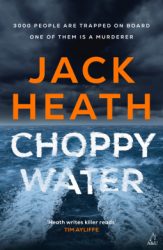
A woman's body is found in a laundry cart aboard the Silver Lady cruise ship. Management says it was a freak accident and her death is quickly covered up, so as not to spoil the voyage for the passengers.
Cesar Cain doesn't want to get involved. He boarded the Silver Lady to disappear. If the cops find him, he's in a cell. If the Hell's Hounds catch him, he's in a grave.
But it's March 2020, and the borders are slamming shut. Cesar soon discovers that the woman wasn't the first victim - and with the ship suddenly quarantined and unable to dock anywhere, she won't be the last ...
Choppy Water, Jack Heath
There is no doubt that Jack Heath is a prolific author, and CHOPPY WATER is his latest (currently) standalone novel. In a style that's similar to previous books - the "Kill Your ... " and the Timothy Blake series in particular, it has all the thrills, spills, action and irony that you'd expect, with a touch of dry, dark humour. What you end up with is a heart stopping, and frequently moving, thriller with a believable scenario at it's core: a wanted and haunted man, looking to disappear, who finds himself working (he has an ulterior motive) on a cruise ship, at the beginning of the COVID pandemic, when other people start really, and very quietly, disappearing at the same time as a dead body shows up in a very bizarre manner. Someone who was definitely not a victim of the virus.
That body, a young woman horribly disfigured, is discovered in the housekeeping trolley of one Cesar Cain - a man who is not who he says he is, somebody with a bunch of reasons for not getting involved in any murder investigations. He's on this cruise ship as part of a plan to disappear, because if the cops find him, he's going to jail, and if the bikie group the Hell's Hounds find him, he's going to die.
It turns out that the the first woman is surprisingly hard to identify, given the locked room / closed community of a cruise ship. And yes - that was "first" as bodies do seem to be piling up - leading to a bit of fretting from some about the message of a serial killer onboard getting out at the same time that everybody's already dealing with the thought of a deadly virus spreading. But the initial death is gruesome, and the details are not for the weak of stomach. Cain is comfortably sanguine with a fair mount of gore though, as he finds himself sucked into a murder investigation because the head of ship security is desperate to write it off as an "accident", and Cain's having none of that. His reasons for the reluctance, and ultimate involvement, are gradually revealed as the story progresses - from a very confrontational prologue, through the death of that young woman on board, some disappearances, and some very weird behaviour and dodgy goings on - all while the stories of the deadly virus, and problems in finding somewhere for the ship to dock because of it, start to send a lot of passengers batshit crazy.
There is a lot going on in CHOPPY WATER and readers who pay attention to the small things will be rewarded with some "I thought so moments". You can also refuse to sweat the little things, and charge through this as a rip roaring thriller that belts along at a great pace, twists, turns and pivots left right and centre, and covers a lot of ground for something that is taking place in a very confined location. The subplot around the pandemic panic does add touches of gallows humour, but really, the goings on - in both Cain's life and on the ship - are the main focus and there's less that should be funny in either of those, if you don't count the vicious "funny business" that is eventually unearthed. Turns out there's a lot of that, as there has been in Cain's past - funny and decidedly not funny.
Tinged with a bit of romantic longing, with a hefty "ships that passed in the night" metaphor going on, there's even a close encounter with a shark which very nearly had me cheering in the middle of the night. There are hints at the end of this novel that there could be more to come in Cesar Cain's story - would be interesting to see where he doesn't disappear to next.
Something He Did

In the gridlocked heart of Melbourne, a split-second of road rage changes everything. For one driver, the crash is a bizarre stroke of luck that sets their life on an upward trajectory they never thought possible. For the other, it is the first domino to fall in a terrifying downward spiral.
Detective Sergeant Claudia Russo doesn't care about the insurance claims—she’s focussed on the search for a missing eighteen-year-old girl. But the girl’s father, a man defined by entitlement and influence, is playing a dangerous game. He’s more afraid of his own double life being exposed than he is of his daughter never coming home. Claudia has secrets too: she’s grieving a tragic loss of her own and losing control of an on-the-job romance that threatens to unravel everything she has worked so hard for.
As all their fates become more entwined, the lesson must be learned: Be kind. Or suffer the consequences.
Something He Did, SK Lynch
Readers of SK Lynch's first novel, SOMETHING HE DID, might like to know a couple of things first up. She is working on a sequel, important as you're going to have questions, so many questions, at the end of this, and despite the reference to the wonderful BROKENWOOD MYSTERIES TV series in her bio, there are no old Holden cars, country music, and quirky characters here. Far from it to be honest. And for those worried - this is not an ending that comes with one of those cliffhanger, "and in the next book endings"... sort of.
Billed as "The novel with the best twist you'll read this year", there is so much more to SOMETHING HE DID than just a twist - a doozy which hindsight might make you feel you could have seen coming, but hindsight has been known to lie through it's teeth. It's absolutely a thriller with an opening half that seems a bit, well floaty, for want of a better description. That section shares the story between Amber - a young mother with a drug problem - fighting for access to her daughter, and struggling with constant setbacks - some of which are her own fault, a major one, a split-second of road rage, is anything but. That moment though, a car crash in the early morning traffic of Melbourne, sets Amber's life on a path that has a horrible sense of inevitability about it. What happens to the other party in the crash is less clear. Jake is an ex-rugby player, famous and lauded in his native New Zealand, a bit player in Australia, he travels backwards and forwards from his wife and two daughters at home in Queenstown; to his job, and his girlfriend and young son in Melbourne. The girlfriend knows all about his family at home. His wife and daughters nothing about his other life in Melbourne.
The novel constantly plays with the reader's expectations whilst tearing through the main two characters lives like a wrecking ball. Mistakes come back to haunt, constantly dragging both Amber and Jake through the mire, escalating through both their lives until a couple of major incidents. It's when Jake's elder daughter, a girl already leading a hidden life, disappears in Melbourne that DS Claudia Russo's Missing Person's unit comes into the picture, tasked with looking for a rebellious teenager, pressured from above because Jake has a few contacts in high places and has been throwing his weight around.
What seems like it might be a straight forward thriller styled novel, with readers waiting for that final twist, has a lot more than that going on. From the car crash moment there's something not quite right about that description from the blurb "For one driver, the crash is a bizarre stroke of luck that sets their life on an upward trajectory they never thought possible. For the other, it is the first domino to fall in a terrifying downward spiral." Sure, initially, things might seem to be heading upward and onward for one of the driver's whilst the downward spiral for the other is marked and incredibly confronting to read. Until a daughter disappears, and a father's true nature is revealed, and it turns out the higher you climb, especially if you're using other people as the rungs on your ladder, the further and harder you fall.
Without spoilers though, that twist is really something. As is the aftermath, the conclusion that wraps up this story, and asks a hell of a lot of questions about right, wrong and complicity that will stay with readers until, one supposes, the next book is released. Which I'll certainly be queuing for now.
Cold River

Deep in the mountains, secrets grow deadly . . .
Detective Constable Sally White knows how easily hikers can go missing in Victoria’s high country. But there’s something about the disappearance of Louis Taylor, a young man lost up Mount Viking, that’s not sitting right with her.
Louis was an aspiring journalist, researching the illegal tobacco trade – also known as chop chop – that was once so prevalent in the area. And the last person he interviewed before his hike has just met a gruesome end . . .
But with no other leads, and with the search winding down, Sally is forced to accept the young man died in a tragic accident.
Until she learns of another missing person case that bears striking similarities. Astrid Marlowe, a young lawyer, vanished in the same mountains two years before.
Were Louis and Astrid simply unlucky hikers lost in the treacherous terrain? Or did they both stumble into something – or someone – they shouldn’t?
Near Death in Venice
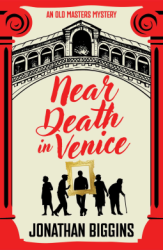
‘I’m a seventy-three-year-old woman, Tristan; I am practically invisible. I’m exactly the sort of person you need to pull off this caper. Oh my God, I can’t believe I just used the word “caper” in a sentence referring to myself!’
Tristan Barclay, art historian, minor TV celebrity and Belvedere Tours leader, is reluctantly embarking on his final tour of European art and culture. But this will be no ordinary excursion to see the old masters – Tristan is secretly planning a ‘grand gesture’ of his own, one that will shock the world.
The only problem is, he can’t complete his mission alone, especially once a budding romance distracts him from his noble quest. Luckily, his tour group are eager to help – and find themselves caught up in a high-stakes heist where danger lurks around every ornate column …
Near Death in Venice is thrilling, hilarious and wildly entertaining.
Near Death in Venice, Jonathan Biggins
This is now the second art based caper novel I've read recently, and as you'd expect from an author with the background of Jonathan Biggins (well known actor, singer, writer, radio host, comedian, dare I say satirist), there is much in NEAR DEATH IN VENICE that is highly comedic, and very stagey. In a good way if you're a bit of a fan of rambling, slightly daft plot scenarios that go from vaguely silly, to engagingly twisty and back again for the entirety of a novel.
Built around central character Tristan Barclay, an art historian and minor TV celebrity (for a lot of wrong reasons ... I mean Antiques Roadshow, hanky panky in the bushes, seems almost sacrilegious!), most recently Tristan has been a tour leader for Belvedere Tours, a fine arts and culture tour group that is owned / run by the son of the founder, one of those chinless wonder types who for reasons that Tristan cannot begin to fathom (nor one suspects can the aforementioned chinless wonder who seems to have gotten himself a millennial staff member who has "ideas") has decided that Tristan is now on his grand final tour.
Only Tristan decides that a final Grand Tour needs a Grand Gesture, one that centres around the nasty habit in the art world of separating triptychs and the like for material gain. A gesture he also firmly believes is less theft and more an act of artistic recovery, one that in the planning seemed somewhat straight forward, that turns out to be anything but. Just as well his final tour group is made up of a bunch of elderly fans of his - groupies if you will - who are more than willing to step in and assist, and after all, what art heist doesn't go better with a mobility scooter involved.
Including a great cast of mildly eccentric elderly's, a potential romance with a twist, and an ex-cop / art theft investigator sort of person lurking around in the background the scenario in NEAR DEATH IN VENICE may be just enough to tip some people into the realm of potential guided tour participants. Although you'd want an iron clad promise that it's going to be more weird heist, and less having to put up with total bores on a bus (or luxury riverboat) for days on end.
Announced as the first in "The Old Masters Series", there's something rather compelling about how somebody bordering on daft as a brush like Tristan comes across, when they have enough sense to surround themselves with can do people, and graciously concede ground. A tour guide who comes up with the itinerary and allows his group to go off piste at will, if you like. And I did like, once I got used to the slightly silly idea behind the whole thing, and the chatty manner of the telling of the tale, and the fact that I seem to be identifying a lot with elderly people willing to behave quite badly nowadays.
The Cross
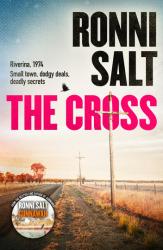
In the dying days of 1974, a mysterious yellow sports car speeds into the quiet Riverina town of Gunnawah. While the locals are initially intrigued by the stranger in their midst, nobody is prepared for what comes next.
At the town's only newspaper, the Gunnawah Gazette, cadet journalist Adelaide Hoffman starts looking into a proposed new resort development on the banks of the Murray. Her street-smart boss, Valdene Bullark, and Val's long-time friend, Wayne Trevaskis, have been around the block and they're pretty sure something shady is going down. Meanwhile, the town's only cop, raw recruit Jack Overlund, is about to learn the stranger has brought more than an oversized ego to the town.
Over the years, the echoing, heat-rimmed days of the Riverina have concealed a lot. A secretive priest. A pregnant teenager. The dark shadows of the Nugan Hand Bank. A faded TV star. A deadly shame. When big city money arrives and long-buried secrets threaten to surface, some will be forced to deal with their past and others will have to grapple with their future.
The richly comic and deeply dark companion novel to Gunnawah, The Cross is set in a time of football, meat pies, Gough Whitlam and shag-pile carpet. A quintessentially Australian crime story of ratbaggery, religion and revenge that deftly blends gripping crime with acerbically funny, moving and distinctly Australian characters.
We Chase Shadows

At sunrise, high in the Italian hills, a body is found on the steps of a beautiful private villa. On the body is a threatening note, signed by a mystery man.
Back at We Solve Murders HQ, Amy, Rosie and Steve leap at the chance to take on their first proper case. So what if their new client seems to have his own reasons for avoiding the police? All they need to do is uncover who left the note, and then find them. Simple.
But once they start digging, the suspects keep piling up: there’s Sweden’s most-wanted criminal, a canny ex-wife and a fierce business rival – yet the murderer keeps evading them. And as the trio chase a villain through the shadows, danger travels closer to home . . .
Between Italy and Palm Springs, via Barcelona and Steve’s village pub, can the team catch an elusive killer who knows EXACTLY where to hide?
Last Days of the Lotus

Saigon, 1968, on the eve of Tet. The Vietnamese New Year draws near, and the city waits, restless and uneasy, the air thick with rumours of ceasefire and the taste of betrayal.
Smith has served his time in the secret world – an Australian case officer grown weary of the lies that pass for intelligence, and the loyalties that dissolve at first suspicion. When a colleague is murdered and leaves behind a single word in a blood-stained notebook, Smith finds himself drawn back into the game he thought he’d abandoned.
The trail leads him through bars, alleys, and burned-out villages, deeper into a war that has already devoured truth and loyalty, where every debt must be paid.
As the city slides towards chaos, Smith must decide what is worth saving and what must be left behind.
In the tradition of The Quiet American and The Spy Who Came in from the Cold, Last Days of the Lotus is a taut, atmospheric novel of espionage, moral fatigue, and slow-burning dread. It is, ultimately, a requiem for the idea of victory.
Last Days of the Lotus, A.C. Edwards
Set in Saigon, 1968, on the eve of Tet, the Vietnamese New Year, it's the middle of the Vietnam War and things are very tense. In the city, there are rumours flying, and alliances being tested, yet it's the murder of the colleague of an ex-Australian spy that sets off a chain of events that devastates lives and relationships, whilst the wider realities of war unfold.
Smith served his time as a Spy, he'd grown weary of the world of intelligence, jaded by the artifice, exhausted by the game. Yet he remains in Vietnam, the love of his life keeping him there, as much as a deep sense of ennui, despite the day to day danger. Which on one level makes the murder of his colleague an unexpected trigger to pull him back into the world of war, spies and espionage. But the murder happened right in front of him, the single word in a blood-stained notebook intrigued him, and ultimately he seems at such a loss for direction, it kind of makes sense that he'd step onto the path backwards.
As he pursues answers through the city, and out into the country-side, the aftermath of the war becomes even more obvious - with burned out villages, death and loss everywhere, and lies and fabrications left right and centre. Returning always to his small shabby lodging, his drugs, and the love of his life, local woman Tâm. The story of how they met, stay together, and live, intertwined with the reality of being normal people in a warzone forms a big part of this novel, as does the city and the complications of everyday life.
Alternating between a tense and very atmospheric telling of place, LAST DAYS OF THE LOTUS sneaks up and mugs the reader right to the very end. There's an ever present sense of real, slow-burning dread about this story, as it builds a picture of people struggling in the face of a vicious war, and those participating in the fight either driven by fervour for "their cause" or drowning in the moral fatigue of "theirs". A complicated character Smith is both beguiling and frustrating - a lost man in a rapidly imploding world, somebody who is both paranoid and incredibly naive. With a plot that's slow burning, and immersive, this isn't your classic spy thriller - there's moral ambiguity on all sides, and a real sense of some people dancing the dance without hearing any of the music.
That slow-burn dread comes with a cleverly pitched sense of inevitability and an invasive sense of the utter pointlessness of war imposed by others - fighting for territory, for righteousness, for power, influence, money, all of the standard reasons why some people are awful, others are lost, and the innocent casualties mount. It comes as no surprise that the author of this work is ex-Military, somebody who has spent time in Asia, who knows the places that he is writing about, as well as the scenarios.
There's a final twist to this tale, in what had been a particularly immersive reading experience. You will have to slow down, you will have to realise that the style is on purpose, and the descriptive tone exactly what is required. As is the first-person perspective, inviting the reader to see and feel this whole story of Smith and his Vietnam War from his perspective alone.
Add comment