I'm not sure what alerted me to the existence of this book, and I'm well aware of the exploitative and often sensationalised discussion around real-life lone killers, and have, in recent years been turned right off some true crime narratives because of it.
The author of this work, Paul E Mullen however has the following bio:
Professor Emeritus at Monash University, Melbourne and Visiting Professor to the Institute of Psychiatry, London. He was Professor of Forensic Psychiatry, Monash University and Clinical Director, Victorian Institute of Forensic Mental Health, and previously Professor of Psychological Medicine at the University of Otago (1982 –1992) and Consultant Psychiatrist to the Royal Bethlem and Maudsley Hospitals and Senior Lecturer at the Institute of Psychiatry, London. He is a principal psychiatric authority on stalking and the co-author of the leading psychiatric textbook on the subject, Stalkers and their Victims, which won the Guttmacher prize in 2001 from the American Psychiatric Association.
In other words, likely to provide a different, and very informed viewpoint. Add that background to his stated and very firmly adhered to aim of not lionising or necessarily even naming (except in one case within the book), the killers themselves, and this line from the blurb:
Mullen challenges myths about madness and violence, revealing these killers not as incomprehensible monsters, but as deeply disturbed individuals shaped by knowable forces. Crucially, he offers guidance for recognising warning signs and improving threat assessment.
And I was keen to read something that may provide some insights not just into the reasons why, but the methodology by which they can be understood, and in any way, mitigated.
In one of the early lead in chapters, Mullen explains the background to "Running Amok" and "Amok Syndrome". In this chapter as well as an explanation of the background of the syndrome, Mullen expands on the steps and methodologies used in the past to address the (in the main) young men who act in this manner and the way that the phenomena was lessened considerably. A salutary lesson which goes on to be proven in chapter after chapter within this book, including some informative insights into the differences, for example, between the handling of lone killer mass murderers in different societies and the consequent outcomes.
Whilst there is potential for the facts of some of these cases to be overwhelming, and the psychiatric terminology required to be used a struggle for the average reader, Mullen's is gifted with a clear and concise writing style that is engaging and informative. At no stage does he wallow in the potential distress or "shock factor" instead, this is a clear eyed, carefully considered and expertly informed discussion of a series of quite appalling acts, many of the perpetrators being people Mullen's has personal experience of talking with and/or treating / assessing.
He carefully and clearly puts forward a case for how many, but not all, likely perpetrators can be identified, how their actions can be de-escalated, or in the event that they do commit acts of mass murder, how their cases, and in particular, their ambitions should be thwarted from there. He draws a stark but very clear example of this in the case of the Port Arthur Killer - a man who immediately after the mayhem was keen to know if he'd "got the record" but because of some luck, and maybe some decency on the part of a lot of journalists, quickly became a pathetic, dim, uninspiring human being, destined to spend his life in anonymity in a jail, confined to a life that was anything but remarkable.
There is much to be learnt from this book - about human nature, and the things that are required to make a potential lone mass killer. About the way that we, as a community, respond in the aftermath, and either feed or quench the potential for more. One also suspects that there is considerably more that could have been said about that, the prevention chapters being slightly less in quantity and depth than the cases discussed.
There is also a very clear reminder that in a world where expertise has somehow become a blight, rather than a gift, experts like Mullen continue to stand out as the sorts of people we should be following - not the grifters, grafters and self-gratifiers that somehow seem to have grabbed today's headlines.
Running Amok
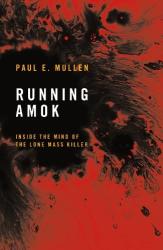
Dunblane 1996. Columbine 1999. Utøya 2011. Christchurch 2019. Lewiston 2023.
What drives someone to commit the unthinkable? In Running Amok, forensic psychiatrist Paul E. Mullen burrows into the minds of lone wolf mass murderers, exposing the troubling patterns underlying their actions.
Drawing on decades of first-hand experience assessing killers such as Australia's Martin Bryant and Anders Breivik, Mullen examines the key forces that unite obsessive rage, personal grievance, a fascination with weapons and a destructive quest for infamy – often culminating in suicide. Mullen challenges myths about madness and violence, revealing these killers not as incomprehensible monsters, but as deeply disturbed individuals shaped by knowable forces. Crucially, he offers guidance for recognising warning signs and improving threat assessment.
Running Amok is both a searing investigation into mass murder and a call to action, urging society to confront these dark realities and prevent the next horror.
Add comment