In Tom Baragwanath’s latest crime novel, Lorraine Henry knows only too well how small towns and close communities are a blessing and a curse.
Tom Baragwanath first introduced ‘Lo’ Henry in Paper Cage, a novel about a small but divided community and a string of missing children. In his latest release, Lucky Thing, Lo is back in a story again concentrating on the dangers that can impact younger people – this time teenagers dealing with petty jealousies, bullying, and partying, and the perils of attraction and social stigma. In a small town it’s easy to assume that because everyone knows who or what they are dealing with, kids should be safe.
A place like Masterton, it’s easy to slot someone away, categorised and neat. Trouble, or no trouble at all. Worth keeping an eye on, or not worth the worry.
While it’s definitely not necessary to have read the first book, Lo is an engaging character, and Paper Cage will give the reader a more complete understanding of how she fits into this place. Masterton is a small town in New Zealand, and Lo works as the files clerk for the local police, although her job has been getting more varied.
Mine has been quite the fluid job description lately. Fetching the biscuits for the staffroom, piecing together Dion’s spidery pages of notes into something the prosecutor’s office can read, covering the Chief’s updates to Head Office while he’s at Bunnings. Light child-recovery duties. And now, apparently, calls to next of kin.
Lo’s also in a unique position in the community. A Pākehā married into a Māori family, she is an insider and outsider in both communities. With no children of her own and her husband now dead after a workplace accident, she’s close to niece Sheena and Sheena’s young son Bradley. She’s used to dealing with young kids, recalcitrant teenagers, and tricky parents – she’s a sounding board for many in the community and the sort of woman who sees, hears, and figures out a lot.
Inside these wet eyes, a flash of colour passes in a brief moment of electricity. I’ve done this enough with Sheena, with Bradley. Shaking the brush and waiting for the bird.
The impending birth of Sheena’s new baby is the main thing on Lo’s mind until a young girl is found beaten and dumped in the cold bush. Jessica Mowbrie is lucky to be alive. But the next person isn’t so lucky, and the discovery of a body really stretches a police unit that’s under-resourced and physically isolated. Their commitment to finding who battered Jessica is unwavering, but the death means competing priorities take a lot of managing. For a force made up of boss Rick Ambrose, beat cop Dion, and a file clerk, it was already a big ask. Take Rick out of the picture due to a violent moment, and the stakes get higher.
The angle of the fall is all wrong, Rick’s arms pinned high and useless, his heavy torso coming down like a load of logs giving way. I move forward to reach him, but it isn’t enough; he hits the pavement, and his head strikes the sharpest edge of the camera.
The key to understanding why Jessica was battered, and the particularly chilling murder, comes down to the connections between people, the locations of events, and a lot of local knowledge. As with all small places, there are the monied few – landed gentry types, mostly white Pākehā families whose kids go to private schools, own a lot of land, and have a tendency to lord it over everyone. An attitude that is mirrored in the teenage community, with girls like Jessica and her cousin from working-class families trying to find a way to fit in with the ‘it’ crowd. As is often the case, the ‘it’ crowd are a bunch of bullies who are in too deep themselves. Not surprisingly, it’s Lo who hears a rumour that might explain some of the tension.
‘See what he knows about the debating club.’ I nod. ‘Apparently some of the Aquinas girls weren’t too keen on having Jessica there. He might have heard something.’
Baragwanath takes a deep dive into the nature of insider and outsider communities in Lucky Thing. Lo has always straddled the two worlds of Pākehā and Māori, landed gentry and working families. He expands that out with Jessica and her cousin, and the two young boys deeply involved in the story, Tāmati and Stu, all dealing with teenage angst against a background of those who have and those who have not so much. Then he takes that scenario right into a family who appears to have everything, and the past events that say a lot about who they are and what they stand for.
Maybe that’s the point of Lucky Thing – those who have everything may not be the luckiest people, because so much tangible ‘stuff’ was acquired by force or manipulation, and subsequent generations have struggled to hang onto it. Perhaps the lucky ones are those with a sense of community, family and connection. Not so tangible, not so easy to lose because of a momentary bad decision.
Lucky Thing
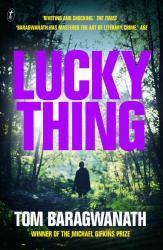
“The nights aren’t too cold yet, lucky thing. Otherwise we’d be having a different conversation.”
Jessica Mowbrie, beaten and dumped in the bush like a sack of garbage and lying comatose in a hospital bed: lucky to be alive.
Lorraine Henry doesn’t think Jess is so lucky. She thinks whoever hurt her needs to be hunted down. But the Masterton police are isolated and underresourced, and to be honest, even though Lorraine works for them, she thinks they’re a bit hopeless.
So it might be up to Lorraine to do the hunting. She’s not getting any younger, of course. But she has all the police records at her fingertips—and as much information about who hates who as anyone in Masterton. Plus, she’s used to being underestimated. And you should never underestimate a middle-aged woman with justice in her sights.
Add comment