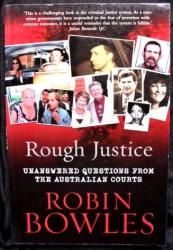
Rough Justice: Unanswered Questions from the Australian Courts examines the question at the heart of our criminal justice system - what happens when our courts get it wrong?
Why is former Victorian police sargeant Denis Tanner a free man if the Victorian state coroner named him as the killer of his sister-in-law, Jennifer Tanner?
Did Greg Domaszewicz really kill Jaidyn Leskie and get away with it because he had a good lawyer?
What was the real cause of the sudden death of young nursing sister Birgit Munro when 24 hours before she died she'd been 'as fit as a flea'?
Why did West Australian alleged hit-run killer John Button confess to killing his fiancee Rosemary Anderson if he didn't do it?
Why won't Bradley John Murdoch tell the police where he hid Peter Falconio's body?
Why did a juror in Graham Stafford's trial call Stafford's mother - after reading a book containing the full story of the murder Stafford had allegedly committed - to apologise for finding her son guilty?
Was Roseanne Catt, who served a ten-year jail term in New South Wales for the attempted murder of her husband Barry, 'an evil and manipulative woman' or the victim of a terrible conspiracy between her husband and the police?
Did Henry Keogh cold-bloodedly drown his fiancee in her bath, or has he served nearly half his life sentence as an innocent man, condemned by an incompetent forensic report?
This latest book by Australia's true crime queen, Robin Bowles, makes no claim to promote the guilt or innocence of any of the people discussed. Rather, it examines the due process of the law and how, at times, that process may not be seen to deliver justice.
Rough Justice, Robin Bowles
ROUGH JUSTICE comes from that section of True Crime books which include telling the story of particular cases, and then analysing aspects of those cases.
As with all these sorts of books whether or not it will work for the reader depends on a number of highly subjective elements - whether you agree with the issues raised by the author (either that they exist or they are issues); whether you agree with the outcome or the methodology of that analysis; and whether or not you like or dislike either the tone of book, the raising of the case, the author or any combination of these and/or any other elements you want to raise.
Makes this sort of book a tricky read for a lot of people and you'd have to be silly not to think that True Crime, in particular, is an easy path for either author or reader.
What I appreciated in this book in particular is that the cases that were raised were raised, that the issues that were highlighted were highlighted, and the analysis that was undertaken was voiced. No idea if I agree or disagree or even came up with my own conclusions in the main. But the justice system in this country has to be robust enough to stand up to scrutiny, which is part of the reason that I read these sorts of books - regardless of the cases, the author, the issues or the period of time that has passed.