'What do you want me to say, Your Honour? Could you have cocked this thing up any worse? Bloody helpless kid and you know she's back out on the street now. You know it, don't you? You're known throughout the state as a heartless old prick and a drunk, and seeing I've gone this far, your daughter-in-law's appointment to the court is widely viewed as a grubby political payoff. She's got about as much ability as you have...'
CHARLIE JARDIM has just trashed his legal career in a spectacular courtroom meltdown, and his fiancee has finally left him. When an old friend slings him a prosecution brief that will take him to the remote coastal town of Dauphin, Charlie reluctantly agrees that the sea air might be good for him.
The case is a murder. The victim was involved in the illegal abalone trade and the even more illegal drug trade. and the witnesses aren't talking.
And as Dauphin closes ranks around him, Charlie is about to find his interest in the law powerfully reignited.
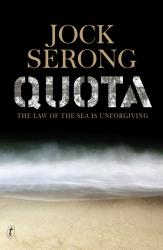
Quota, Jock Serong
It's not unknown for crime fiction followers to point out that it frequently explores the rights and wrongs of society and human behaviour. Because of that it's reasonable to expect that the settings, and central subject matter have unlimited scope, but I think this is the first book I can recall that gets into the question of over-permit limit Abalone catches, as well as the more predictable drug smuggling. The storyline of QUOTA centres around a dispute between two families in a small coastal town and the murder of Patrick Lanegan's brother on a fishing boat, just offshore, late at night.
Within the setting of a small fishing village in regional Victoria there are the have's (the Murchison's) and the have-not's (the Lanegan's). There's a sense of entitlement about the have's that make them particularly ruthless, and the instigator's of much of the trouble that both families now find themselves in when the Murchison's are implicated in the death of Lanegan. Despite the question marks over both families behaviour there is much that is sympathetic about the Lanegan's making them easy for a reader to connect with. Which seems to affect big city lawyer / fish out of water character Charlie Jardim as well. Seconded to this case as a last ditch hurrah for his legal career, borderline terminal after a massive spray at a Judge during a Court hearing, it's through the kindness of friends that Jardim finds himself briefed as junior for the prosecution. When this role takes him to the fishing village of Dauphin on the basis that he, and Senior Counsel feel that there's something not quite right about Lanegan's statement, even the getting there is fraught with the problem that many city drivers find when they head to the bush. Kangaroo's are frequently big, and hitting them is extremely problematic for the kangaroo and drivers. Once on the spot, as he starts to understand the Lanegan's situation, and find out more about their lives, there is something about them, and this odd little town that he connects with.
Jardim is wonderfully dry, and surprisingly taciturn given that aforementioned courtroom spray. He's damaged obviously by his past (there are fleeting references to a brother who has died), but in many ways QUOTA isn't a novel solely devoted to building Jardim's character and background. He's also romantically entwined with a woman who is particularly driven. Which, with all the will in the world, you could never say about Jardim. Their relationship, even allowing for opposites attracting, seems to befuddle Jardim almost as much as it might a reader, but again, the vagaries of his personal life are not explored in minute detail. Because there is much that's sketchy, withdrawn about Jardim he could befuddle readers, even be a little off-putting. He'd be a tricky sort of bloke to know - fictionally or in real-life and somehow that makes him all the more intriguing and baffling.
QUOTA is a look at small town life in Australia, as well as something of an investigation into the class differences that might not be mentioned, but do exist here - frequently to do with money and influence. It's also a courtroom drama and whilst Jardim continues in his role as investigator and seeker of truth, once the action switches to the courtroom his influence is lessened, and senior Defence and Prosecution Counsel take over. Here much of Jardim's activities in Dauphin come in for some scrutiny and the novel really does give the reader a view of the verbal and tactical games that make up much of a criminal trial.
As is frequently the case though, this author is definitely writing about a world that he knows (a lawyer himself, living in a smallish seaside town in Victoria), but that doesn't always translate to something believable. In QUOTA however we have pitch-perfect dialogue, and a strong sense of place about this small town in particular. The characters there are particularly believable and even allowing for the slightly off-camera nature of Jardim, actually quite likeable (a bonus). All of these elements combine to make for a very engaging, and extremely realistic debut novel.
Originally published at ReviewingTheEvidence.com